Wednesday, June 4, 2014

New Responsibilities

                                
                                       Elder Tague in San Pedro, Ambergris Caye

On May 21, 2014, Elder Tague was set apart as the second counselor in the El Salvador San Salvador West/Belize Mission Presidency.  Needless to say, our activity level has grown considerably.  He is responsible for the Belize City District which consists of five branches in the east and north of the country: Belize City Branch, Cinderella Branch (Spanish branch in Belize City), San Pedro Branch, Orange Walk Branch, and Corozal Branch.  We are only in our home branches in Belize City once a month now.  Every week we are travelling to one of the other branches.  

Our first official visit was to the branch in San Pedro on Ambergris Caye.  We took a little 4-seater plane to the island which only took 20 minutes.  There is a water taxi that goes to the island but it is a 1 1/2 hour ride and the seats are hard.  On Sunday, the water taxi doesn't get there in time for the beginning of the meetings.  The little plane was not only a fun adventure but a necessity.

                                   
                                                The pilot's panel of guages

                                               
                                                            Elder Tague, co-pilot

We arrived in plenty of time for the meetings.  There were about 65 people in attendance.  It's a mixed group of Spanish speakers and English speakers so the meeting is conducted in both languages.  Surprise! Elder and Sister Tague became the main speakers.  We had not planned anything but since it was our first official visit, they decided to change their program.  It was a case of extemporaneous talks.  I took a leap of faith and spoke in both Spanish and English, translating for myself.  Amazingly, it went quite well.  (The Lord does bless missionaries with the gift of tongues).  One of the Elders translated for Elder Tague.  It was a very good meeting.  After church, there was a baptism which was again performed at the beach.  

                                      
                                                          The church in San Pedro

                                       
                                                                     The baptism

We stayed over night in San Pedro because the Elders there needed to find a new apartment.  Their landlord decided he didn't want to rent to missionaries for some reason.  We stayed at a small hotel right on the beach where the sea breeze was refreshing and the view was lovely.


                                                     Outside our hotel door.

       
              The view of our hotel from the pier.  Our hotel room was in the building on the right.                                                       

We spent Monday working with the Elders and looking for a new place for them to live.  The most common mode of transportation on the island is the golf cart.  There are golf cart rental places every 2 feet it seems like.  We rented one, of course. There are lots of bicycles, some motorcycles, and some delivery trucks. The only other vehicles on the roads were the ever present taxis.  These were usually SUV's.  The streets are narrow and the actual cars and trucks were almost too big.  The missionaries ride bikes.

                                            
                                                      Following the missionaries 

We are still negotiating a new home for the Elders.  We have some good possibilities but the contract  has to be accepted by the mission legal office so we are waiting for the paperwork to be completed.

There was an Elder in Orange Walk who was leaving for his mission in the Virgin Islands on Saturday, May 31.  We went to Orange Walk on Friday for Elder Tague to set him apart for his mission.  That was another first for Elder Tague.  We are going to really enjoy getting to know the people in all the branches in our district.  There are so many wonderful people here and we feel priviledged to be able to associate with all of them.


Friday, April 25, 2014

The church in Belize


The Church of Jesus Christ of Latter-Day-Saints is very young in the country of Belize.  Missionary work began May 5, 1980.  The first 10 missionaries arrived the next day.  The first meeting of the newly organized branch was held on May 11, 1980.  The first person to be baptized into the church in Belize was the older brother of our District President.  He was baptized on June 1, 1980 in the Cayo district of Belize.  The Cayo district is the western area including the towns of San Ignacio, Santa Elena, Succotz, and Benque Viejo where the border crossing to Guatemala is located.  The first meetinghouses  were built in Belize in 1987 and were located in the northern city of Orange Walk and the western city of San Ignacio.  At that time there were about 1,000 members in seven branches in the country.

There has been great growth since then here in Belize.  Currently we have 60 young missionaries, both elders and sisters, as well as 5 senior couples.  The work is blossoming in Belize.  We currently have 10 meetinghouses and some are due for expansion in the near future.  However, there are no stakes or wards in Belize.  It is still the Belize District, recently changed from the Honduras Mission to the El Salvador San Salvador West/Belize Mission.  


Since the church has only been established here for a little over 30 years, the members are predominantly first generation with some second generation members for leadership.  There are children coming up and missionaries who have already served or are preparing to leave soon but they are few in number.  Nevertheless, the number of baptisms are growing.  Here in Belize City 14 baptisms occurred in April.  What is desparately needed here is priesthood leadership.  Many more women than men join the church (which I suspect is pretty common world-wide) but in order for Belize to establish a stake, we need enough priesthood to lead it.  The going in that regard is slow.


           When we dedicated the new building in San Pedro on Abergis Caye, there were 2 baptisms
           on that occasion as well.  They were baptised in the sea since there is no baptismal font in      
           in the building.  The building is only a couple blocks from the beach.

                              
                                        This is the new building in San Pedro.

                               
             Some of the Elders sang a special song for the dedication.  I accompanied them.

One of the biggest stumbling blocks toward that goal is the general attitude toward marriage.  Most people just don't see the need.  Many have stable relationships with several children but are not married.  The missionaries not only teach the gospel but end up frequently as marriage brokers.  Investigators are converted to the gospel but they need to be legally married before they can be baptized.  It's interesting.  We have had quite a few marriages throughout the country lately which is definitey helping.  There are good, faithful, wonderful members here but we need more.


                         This is a couple that were married and baptised in Belize City.

                                   
Preparations for a wedding in Orange Walk.  There is no cultural hall in this building so they use the chapel.

Another problem that we face is the lack of transportation.  The missionaries are rather limited in the areas where they can teach because we have to take into consideration if they are going to have to walk to the church, which could be several miles, or if they might have some form of transportation, be it bike, motorcycle, car or bus.  The buses don't run at convenient times for church attendance, however.  For the most part, whole families walk to church.  Belize City is cut in half by the Belize River.  The Belize City meetinghouse, the largest in the country, is located on the south side of the river so anybody living on the north side of the river has a very long trek.  Even with all these obstacles, we have approximately 135 active members in the English speaking Belize City Branch and around 50 active members in the Spanish speaking Cinderella Branch here in Belize City.    

                               
                                    Looking across the Belize River from the north.

Elder Tague and I are focusing  on reactivation.  There are far more members on the rolls than actually attend church.  We are getting to know as many as we can in order to fellowship them and help them with any questions or problems that they may have that might be keeping them from coming to church. So far, we have had some success.  We are really getting to know and love these people.  There is tremendous poverty here but the people seem to be content and cheerful in their circumstances.  Of course, there are some quite wealthy people, as well, but the chasm between the rich and poor is gigantic with very little middle-class.  We feel very priviledged to be able to be here and get to know these people.  We are learning so much from them as well as learning things about ourselves that we never realized before. All I can say is the gospel of Jesus Christ is true.  As we spread the "Good News", we are all blessed.

                                
                                             The Belize City Branch after church.

Thursday, February 27, 2014

Helping Hands in Belize


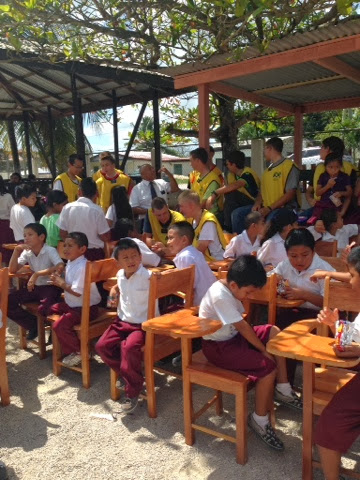
The church in Belize, working with the Mennonites, donated about 500 student desks to 5 primary schools in 4 cities in Belize: Belize City, Ladyville, Crooked Tree and Orange Walk Town. We had a wonderful day.  The church contracted with the Mennonites to construct the desks and the missionaries and leaders of the District distributed them.  We were able to wear the LDS Helping Hands shirts which was fun since people all over the world recognize them.  Unfortunately, Elder Tague and I didn't get our shirts because when they were handing them out, we were shuttling missionaries to and from the church distribution center.

The distribution center had been stacked to the ceiling for a few weeks with desks.  It was so full we couldn't even have any meetings there.  We started preparing to load the trucks on Thursday evening, February 20, 2014. The elders made an assembly line from the upstairs rooms down to the front yard.  It was quite a project.


But, as all good plans must sometimes go awry, the trucks didn't show up.  They got the times and dates mixed up so all the chairs that had been brought down had to be repaced inside the building.  
Luckily, they had only brought about 120 chairs down and they were able to find space downstairs to store them overnight.  

The next morning at around 6:00 am, the trucks were there and all the loading was completed.  Some desks were going to a school in Ladyville which is just outside Belize City on the Northern Highway.  One truck and several missionaries went there first.  

We were assigned to take 65 desks to Crooked Tree.  This was quite an adventure.  Crooked Tree is a very small village about 50 miles north west of Belize City.  We took Elder McCleery and Elder Fowler with us in the car and the truck followed.  To get to Crooked Tree, you go on the Northern Highway for about 40 miles and then turn off on a dirt road and go west for another 10 miles or so.  The interesting thing about Crooked Tree is that it is along the banks of a lagoon.  You have to cross the lagoon to reach the town.  The town is surrounded by marshland which has been designated a wildlife refuge.  

During the rainey season, the road actually is submerged from flooding and the only way in or out is by boat across the lagoon.  Last month the road was submerged and there was still some areas with large puddles that we went through.  


                          We stopped to take pictures of the lagoon on our way into town.
                                  
                                  
There was a white egret on the road and I got some good pictures of it.  There was also a boat out on the lagoon as we passed.


When we drove into town, we passed a quaint thatched roof building and a cute sign.  Cashew trees practically grow wild there.  We found the school and the principal was really happy to see us.  They really needed the desks.  It was a cute school and the students were very helpful and polite.  The boys formed a line to unload the desks.  


                                                      Some pictures of the campus.


      We got a picture with the principal and President Jaime Chi, our district president, who was coordinating the donation. 

After we finished at Crooked Tree, we drove on another 30 minutes north to Orange Walk to meet the other trucks and missionaries and help unload the rest of the desks.  Three hundred plus desks were delivered to 2 schools in Orange Walk.  


It was such a great experience to see how excited these schools were to get these desks.  Many of the children had been sitting on benches with no backs or on little stools.  The children were so excited to have a real desk.  We saw some beautiful areas of Belize that we probably wouldn't have had an opportunity to visit, as well.  All in all, it was a wonderful day.  We made the hour and a half drive home tired but happy.


Wednesday, January 8, 2014

Visiting the Mayan ruins at Lamanai

                               
We had the opportunity to go to the ruins at Lamanai which are several hours from Belize City via some really awful roads but well worth the long hours and discomfort. Our mission president, President Hintze, his wife and two of their daughters and son-in-law, came to Belize from the mission home in San Salvador to bring their family to Lamanai  They invited the missionaries in Belize City to come with them.  We, of course, jumped at the chance.

The day started early since it would be an all day excursion.  We met at the Belize City Distribution Center for the church.  The elders rode their bikes to the Zone leaders apartment where we picked them up in the 12-seater van.  Then we went to the distribution center to meet President Hintze and his family.  They had rented their own car.  We were pretty packed into the van.  There were Elder and Sister Moulton, (Elder Moulton was driving), eight young elders and us. We also had Igloo containers filled with picnic goodies for all of us and plenty of water.  

We set out on the Northern Higway in good time and it was pretty crazy with all those elders cooped up in a small space for so long.  One of them had received a harmonica for Christmas and started to play it but Sister Moulton and I had to put a stop to that.( Arrrrgh!!) We just couldn't handle that for two and a half hours.  It was fun, though.  The roads, as I may have mentioned before, are pretty bad.  This is the main highway that goes north through Belize all the way to the Mexican border so you would expect it to be maintained a little better than most.  Actually by Belizean standards it is a good road.  However, the Belizeans have a strange way of preventing speeding on their highways and roads.  They put speed bumps and "pedestrian crossings" every few miles on every major road.  They are anywhere from 6-8 inches high and a foot or more wide that go from one side of the road to the other.  The pedestrian crossings are actually poured cement raised about 8 inches and flat across for about a yard.  Needless to say, every car that wants to retain their axle has to slow down from a cruising speed to almost stopped to go over them.  It's pretty hard on the transmission and shocks to say the least.  It also takes a toll on the passengers' backs and necks.  Pedestrian crossings are placed at bus stops and in villages along the way.  There are buses that cruise the highway taking pasengers to and from Belize City and outlying towns and cities such as Orange Walk Town and Corozal Town.  

To get to Lamanai, you have to turn west off the main highway after crossing the Macal River just before Orange Walk, onto a rural road that is basically dirt.  This road is a nightmare.  It had been raining for several days prior so the potholes were horrendous and in some places almost impossible to navigate. We could only go about 30 miles an hour at best.  A lot of the time we could only go about 15.  It took almost as long to go 28 miles as it did to go all the way to the turn off which is just a little over 60 miles.  We literally bounced all the way.  Several of the holes sent a few of us almost to the ceiling of the van more than once.  


The best part of that road was the part that went through the Mennonite settlement.  The road was still awful but it was interesting and even entertaining at times as we worked our way through the horse and buggies.  We actually encountered a traffic jam consisting of about 5 buggies going in various directions, a truck coming the opposite way and our van.  It was iinteresting to see young boys driving their buggies with their younger siblings as passengers.  Frequently we saw a mother with two children (always two for some reason) drving the famly buggy.  The usual configuration was two men, a man and his wife, a mother with two children, or a young boy with one or two siblings.  They couldn't be classified as particularly friendly although several men did wave.  The women were more likely to have an expression that I would have to characterize as a scowl.  We also ecountered children walking along the road often barefoot, which was quite reasonable since the road was muddy and they probably had better traction barefoot.  The little girls were particularly eye-catching with their pure white headress that looked as if they were starched and pressed to perfection.  They had extensions in the back that crossed and extended to about mid back.  It was amazing how white they were.  


Not long after the Mennonites, we made the final turn into Lamanai.  We were excited to finally be there.   


The actual archaeological site is a short walk on a path through the jungle from the parking area.  There is just a little sign with an arrow indicating the direction to go so we plunged on into the unknown as it were.  As we emerged from the jungle path, it became a brick paved walkway which led to a small museum/office where you pay the fee along with some thatch covered areas with picnic tables and some souvenir shops built like native huts with thatched roofs.  It was very picturesque.  We were anxious to get right to the excavated temples, etc. so we didn't stay in that area very long.


We were very lucky that it didn't rain at all while we were there.  The pathways were already muddy so it would have been really bad if it had rained.  The elders and President Hintze's kids were already climbing up the first ruin, the Jaguar temple, by the time we older folks got to the clearing.  It truly is amazing!!  Absolutely breathtaking.  Elder Tague and Elder Moulton climbed up to the top of the first one.  It is not as high as the biggest one that we came to later but still a good climb.  President, his kids, and all the elders got to the top for pictures. 


 We wandered through some of what they have determined were houses for the leaders of the community and also the recreational ball court.  Suddenly we turned down a corridor of low walls and before us was the magnificent Lag temple rising 125 feet from the jungle floor. What an impressive sight!! Of course the elders were scrambling up the stairs as fast as they could go. People climbing up looked like ants.  It was amazing.  Elder Tague climbed to the first level but not any farther.  The stairs are very difficult to climb because they are about half the width of a normal foot.  In order to climb you either have to do it sideways to get your whole foot on the step or climb just using the front half of your foot, essentially climbing on your toes.  It's exhausting.  


While we were there contemplating the immensity of it all, we started hearing the most unbelievable sound.  It was loud and almost terrifying coming from the surrounding jungle.  We were told it was Howler Monkeys.  They were howling all right.  It was deafening at times.  Here is a picture of one. 


We continued on through another patch of jungle to the Temple of the Mask.  This is a picture that many will find familiar.  We had to take the requisite portrait of us with the mask.  


We finished our expidition and made our way back to the picnic areas for lunch and relaxed for awhile before heading back to the cars.  Elder Tague went to the little market and bought a shirt with howler monkeys on it. 


We all headed back to the van and piled in.  It was a quieter ride back.  We were all pretty tired but it was a wonderful and memorable day.

After we got home, I found a book on one of our shelves called "Book of Mormon-Mesoamerican Geography: History Study Map" written by V. Garth Norman.  It is quite interesting.  It presents a map that connects Book of Mormon cities with archaelogical sites in Central America.  It suggests that Lamanai was the land of Jershon in the Book of Mormon.  Very interesting.